
LANDMARK · JONGDAL-RI · HADO-RI
Just North of Seongsan: A Half Day in Jongdal-ri and Hado-ri
Jimibong view · Jongdal-ri village lanes · Tokkiseom and the birds · Hado Beach and Byeolbangjin · Sehwa market
Published 4 min read
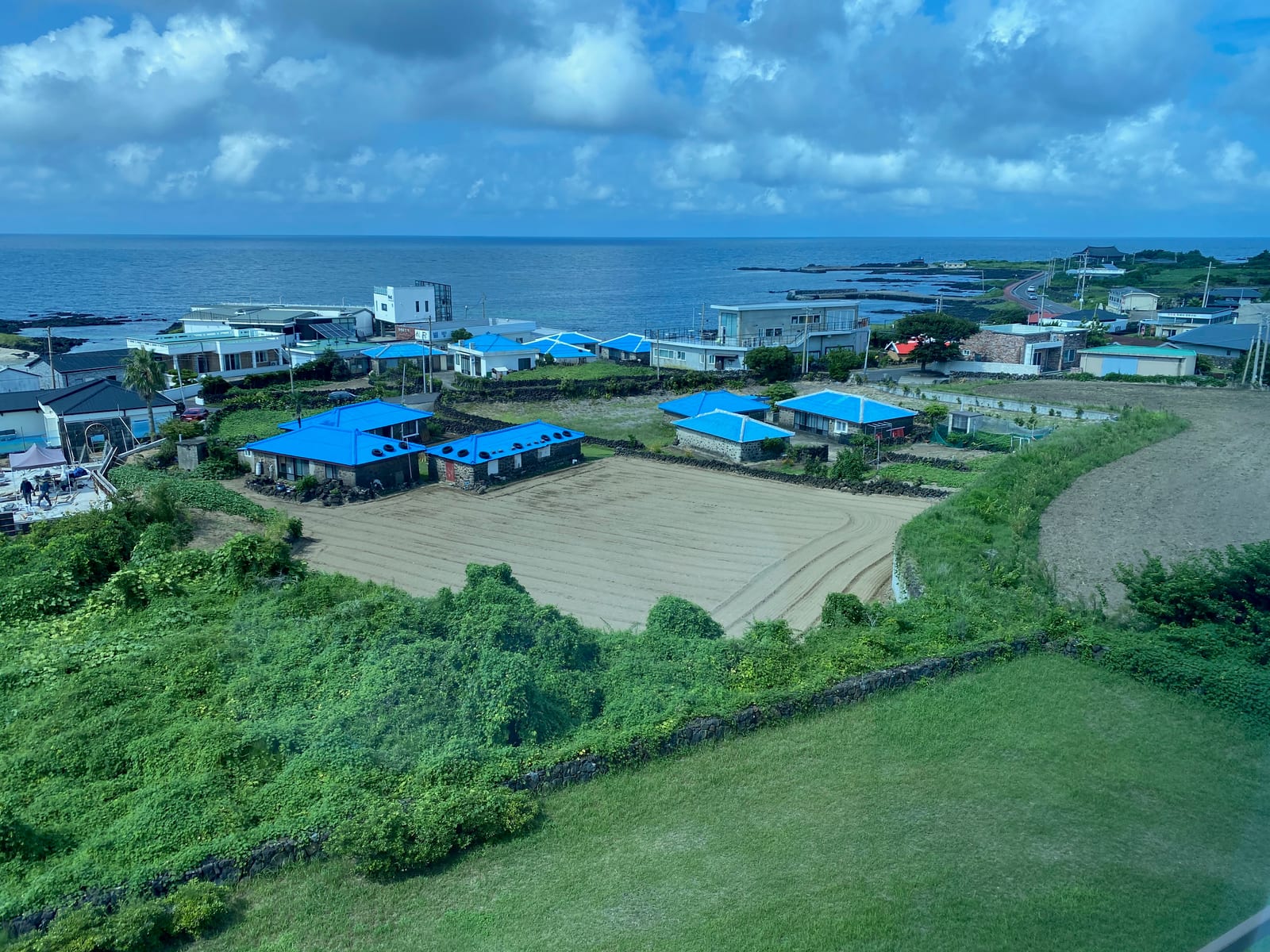
Jongdal-ri and Hado-ri are the easternmost coastal villages of Gujwa-eup, just over the boundary from Seongsan. They are about 15 minutes from the house by car, yet far fewer visitors come here than to Seongsan or Woljeongri, so you can take in a hilltop view, village lanes, wintering birds and a Joseon fortress in one quiet half day. We go in order: Jimibong, Jongdal-ri village, Tokkiseom, Hado Beach, Byeolbangjin, and finish at Sehwa.
Jimibong: Udo and Ilchulbong in one frame
Jimibong is a horseshoe-shaped volcanic cone 165.8 m high that rises 160 m above Jongdal-ri. There is a large car park and toilets at the entrance, and a path of tyre matting and wooden steps reaches the top in 20 to 30 minutes. It is fairly steep, so wear trainers and take care coming down. Two viewing platforms on the summit put Udo, Seongsan Ilchulbong, Jongdal harbour and the open sea into one frame, with the Hado bird sanctuary to the west. The remains of a Joseon-era beacon tower are on top, and around midwinter the sun rises between Udo and Ilchulbong, which makes it a sunrise spot. Jeju Olle Route 21 crosses the hill and ends at the Jongdal shore below.
Jongdal-ri village: hydrangeas, salt fields, bookshops
- Hydrangea road — Along the Jongdal-ri coast road (around Haemaji Haean-ro 2121) hydrangeas peak in mid-June, and in some years run late from the end of June to the end of July. There is a cycle path and pavement, but cars use the road, so take care when photographing.
- Old salt fields — Jongdal-ri was the first and largest salt-making village on Jeju, and its people were nicknamed the "salt folk". In the early 1900s some 160 villagers worked 46 salt cauldrons here; land reclamation between 1957 and 1969 ended it. A small exhibition room stands in front of the village hall.
- Bookshops and cafés — Among the stone-walled lanes are small bookshops and cafés, including Sosimhan Bookshop (Jongdal-dong-gil 29-6), which sells independent publications. Hours vary by day and season, so check before you go.
- Jongdal-ri observation deck — A ship's-deck-shaped platform on the coast road (Haemaji Haean-ro 2196) with telescopes for Ilchulbong to the east, Tokkiseom to the west and Udo offshore.
Tokkiseom and the Hado bird sanctuary
Tokkiseom, "Rabbit Island", lies 50 m off Guldong harbour in Hado-ri and is Korea's only natural colony of the crinum lily, protected as a Natural Monument since 1962. From late July to September white flowers cover the islet, opening fully at night with a strong scent. It is said to be reachable at low tide, but the official guidance is that hollows deeper than an adult's thigh remain even then and that it is very dangerous, so view it from the deck or the shore. West of the islet, separated from the sea by a single dyke, the Hado-ri sanctuary is a brackish wetland where some 30 species and 3,000 to 5,000 birds winter each year. Spoonbills, black-faced spoonbills and swans are the stars, and the season runs from late October to mid-March. There is a hide with telescopes and free parking. The perimeter path has been closed during avian flu outbreaks in the past, so check in winter.
Hado Beach and Byeolbangjin
Hado Beach is a wide stretch of sand on a shallow, calm bay with Udo straight ahead. People surf, kayak and snorkel here; showers are paid (2,000 won for adults, as of October 2025) and seasonal. It is not a designated beach, so there are times with no lifeguard. About 2 km west along the shore is Byeolbangjin, a fortress built in 1510 when a garrison was moved from Gimnyeong to guard against Japanese raiders approaching via Udo. Some 950 m of wall survive, among the best-preserved of Jeju's fortress walls. It was designated a Jeju Provincial Monument in 1974, is free and always open, and you can walk the full circuit on top of the walls. In early spring rapeseed flowers bloom below the black stone.
Sehwa market, the route and the seasons
Sehwa is 2.6 km west of Byeolbangjin. The Sehwa Haenyeo Folk Five-Day Market sets up about 150 stalls on the 5th, 10th, 15th, 20th and 25th of each month from 08:00 to 15:00, strong on seafood and snacks, and many stalls close after lunch, so come in the morning (as of October 2026). Sehwa Beach is next door, and the Jeju Haenyeo Museum in Hado-ri (9 am to 6 pm, closed the first and third Mondays, 1,100 won for adults) has its own guide, Haenyeo Museum and the Sehwa sea. From the house it is about 13 km and 16 minutes to the Jimibong car park, then 5 minutes to Hado Beach, 4 to Byeolbangjin, 4 to Sehwa, and about 17 km and 20 minutes from Sehwa back to the house. Bus 201 stops at Jongdal Elementary School, Hado Elementary School and the Sehwa transfer stop. For a half day go Jimibong, the Jongdal-ri coast road and deck, Hado Beach, Byeolbangjin; on a market day do Sehwa first in the morning and run the loop in reverse. Hydrangeas are best in June, crinum lilies from late July to August, birds from November to February, and the Jimibong sunrise in winter.
Places in this guide
Map of places
Numbers match the map pins. Open any place in Kakao Map, Naver Map or Google Maps.
Map data © OpenStreetMap contributors
Sight
Jongdal-ri village
Hydrangeas in June · salt-field exhibit · small bookshops
Sight
Jongdal-ri observation deck
Ship-deck platform · telescopes for Tokkiseom and Udo
Sight
Tokkiseom (Rabbit Island)
Crinum lily colony, Natural Monument · blooms late Jul–Sep · view from shore
Sight
Hado-ri Migratory Bird Sanctuary
3,000–5,000 wintering birds late Oct–Mar · hide
Sight
Hado Beach
Faces Udo · shallow and calm · no lifeguard at times
Sight
Byeolbangjin Fortress
Built 1510 · 950 m of wall survive · free
Sight
Sehwa Beach
Five-day market on dates ending in 5 or 0
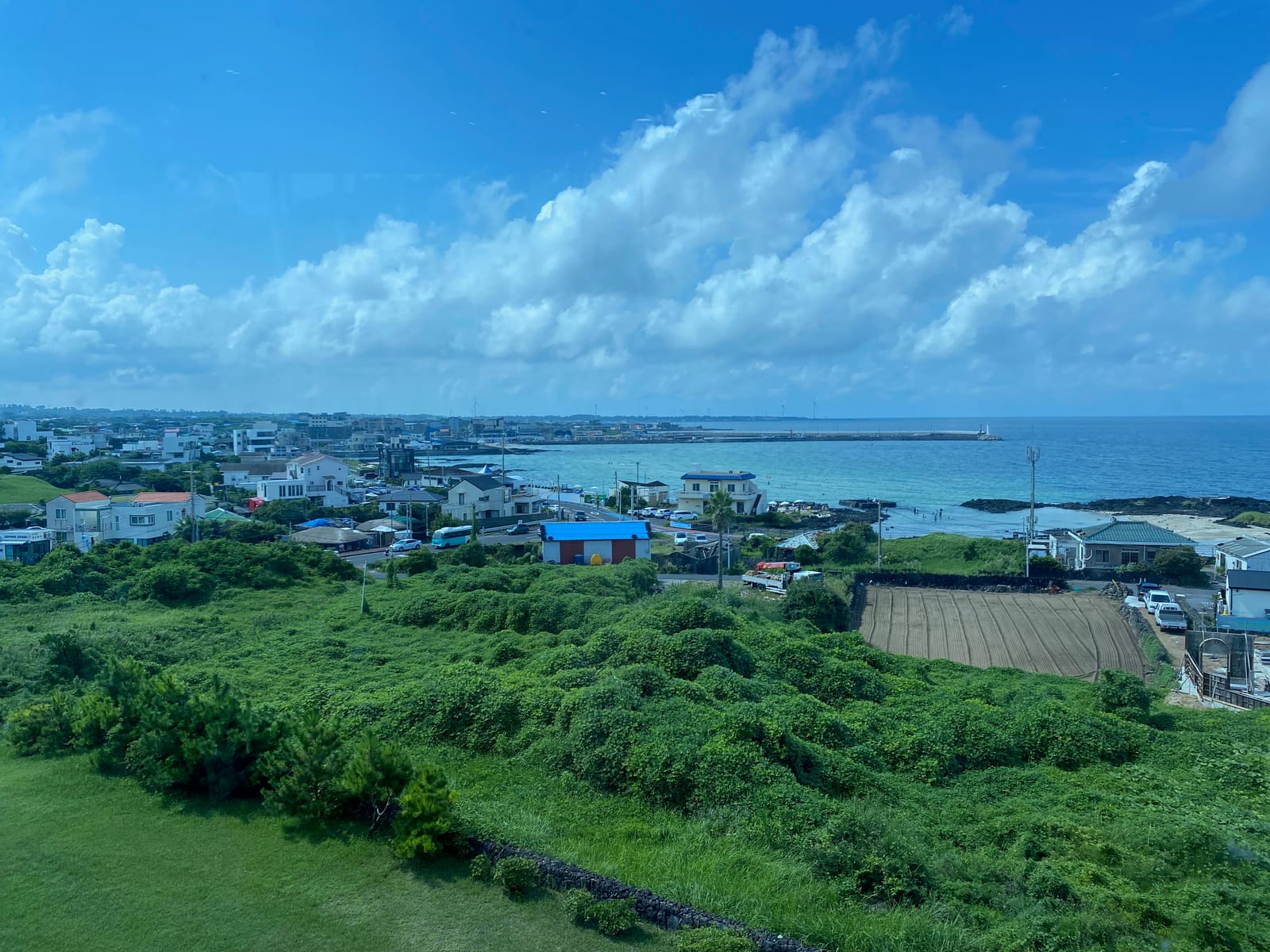
Photo: Sgroey · CC BY-SA 4.0 · Wikimedia Commons Stay
Jeju Daily
Private house, one group a day · about 5 min by car from Ilchulbong

Questions
Questions
Q. Can I walk out to Tokkiseom? +
Q. Where is best with children? +
Q. When is the Sehwa five-day market open? +
Read next
Read next
15 MINUTES TO JONGDAL AND HADO · ONPYEONG
Jeju Daily
A single-story private house in Onpyeong, Seongsan. Climb Jimibong in the morning, play on Hado Beach and be back for dinner, and on market days shop at Sehwa and cook on the BBQ deck. Three bedrooms, two baths, a wide lawn. Up to 12 guests, with the same rate from 1 to 6.